
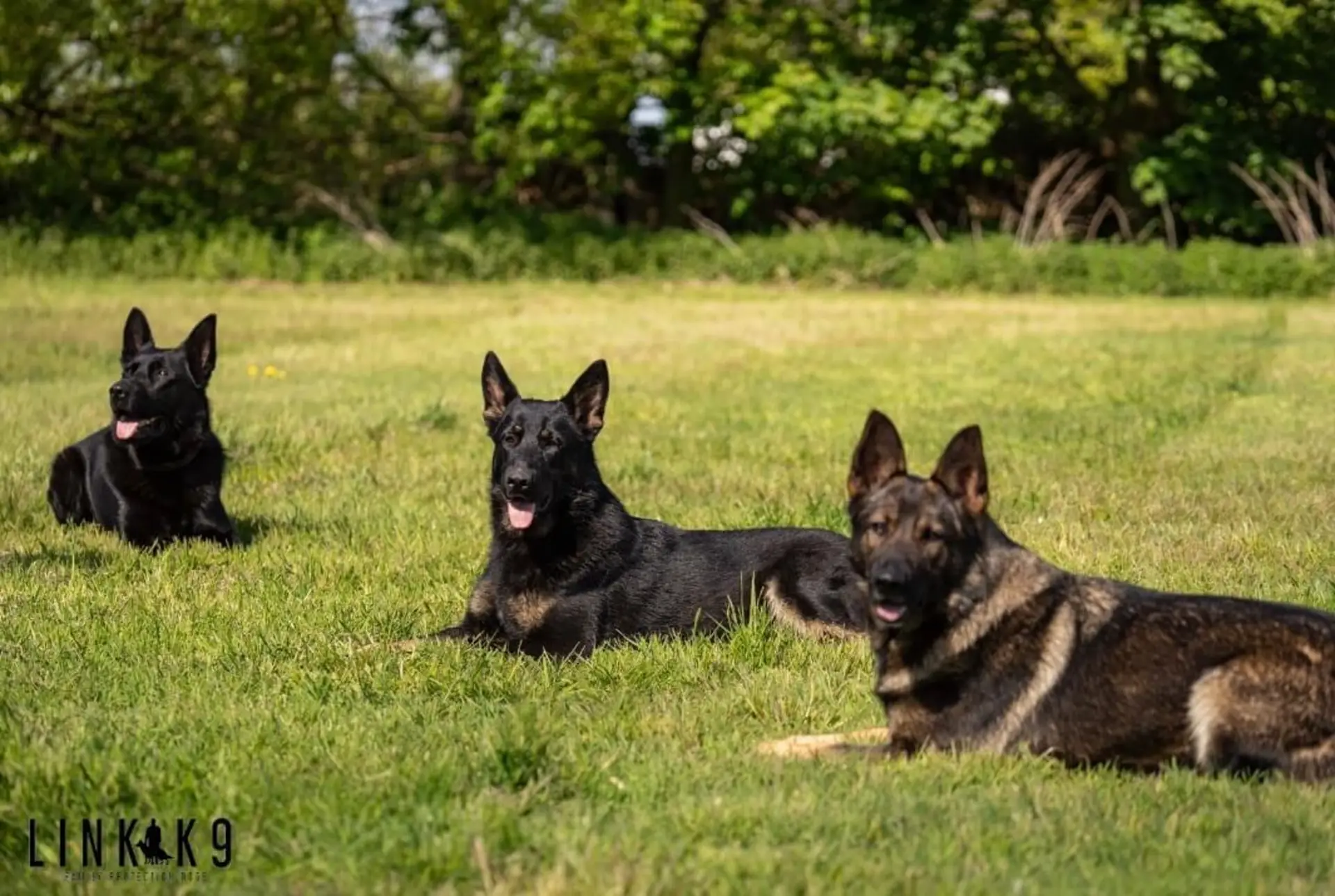
A watchdog raises the alarm, a guard dog defends a place and a protection dog defends a person. That’s the short answer to the protection dog vs guard dog vs watchdog question. The labels often get blurred in everyday conversation, though, and in the UK one of them has a specific legal meaning. That matters whether you’re choosing a dog for your home or your business.
Link K9 has bred and trained protection dogs in Formby, Merseyside, since 2002. Founder Rory Larsen personally trains every protection dog we sell, and the dogs we breed and sell are German Shepherds and Belgian Malinois. In this guide, we explain the differences between the three roles, explore how trainers prepare each type of dog and outline your legal responsibilities as a dog owner in the UK.
The short answer
- Watchdog: notices something unusual and alerts you, usually by barking. It isn’t trained to intervene.
- Guard dog: protects a place, such as a yard, warehouse or compound, by deterring or stopping people who shouldn’t be there. In UK law, a guard dog is one used to protect premises, and the Guard Dogs Act 1975 controls how it is used.
- Protection dog: protects its owner and family wherever they are. It lives as a family companion and responds to a genuine threat under its handler’s control.
Protection Dog vs Guard Dog vs Watchdog at a Glance
| Watchdog | Guard dog | Protection dog | |
| Main job | Early warning | Protecting a place | Protecting people |
| What it does | Barks or alerts | Deters, patrols and guards an area | Steps in when its family is threatened, then stops on command |
| Training | Basic obedience | Guarding work with a handler | Obedience, socialisation and controlled protection work |
| Where it works | The family home | Commercial and other non-domestic premises | Home, car, walks and wherever the family goes |
| Lives with a family? | Usually | Not usually | Yes, by design |
| UK law | Same rules as any dog | Guard Dogs Act 1975 applies at premises | Same rules as any dog |
These categories overlap. A good protection dog is also an alert watchdog, and some working guard dogs are family pets off duty. What counts is the job the dog has been trained and trusted to do.
What is a Watchdog?
A watchdog is any dog that reliably tells you when something is out of the ordinary: a knock at the door, someone at the side gate or a car on the drive at 2 am. Most do it by barking. Others go quiet, stiffen and fix their eyes on the window. The alert is the whole job. A watchdog isn’t expected to confront anyone, and most aren’t trained to.
That makes a watchdog a useful early-warning layer alongside locks, lighting and an alarm. Barking can also put off an opportunist who would rather try a quieter house. Beyond that, it can’t be relied on.
Which dogs make good watchdogs?
Size has little to do with it. Plenty of small breeds are alert and vocal, while some large dogs barely lift their heads when the doorbell goes. Temperament, upbringing and routine matter more than breed.
The aim is a dog that alerts you and then settles once you’ve checked. A dog that barks at every passer-by, delivery driver and visiting relative is giving you noise rather than information. Basic obedience and early puppy socialisation help a dog learn what normal looks like, so its alerts mean something.
What is a Guard Dog?
A guard dog protects a place rather than a person. Its job is to keep unauthorised people out of a defined area, such as a builder’s yard, warehouse or industrial site, by deterring them and, if necessary, stopping them. Working guard dogs usually operate within a wider security set-up that includes handlers, fencing, access control and site procedures.
Training focuses on that work: reliable responses to the handler, confidence in unfamiliar surroundings and controlled guarding. Fearful dogs, and dogs that are aggressive without control, aren’t suitable. Our protection dog training covers business security as well as family protection.
What “guard dog” means under UK law
In England, Wales and Scotland, the Guard Dogs Act 1975 defines a guard dog as one used to protect premises, property kept on them, or a person guarding them. If you use a guard dog at premises:
- A capable handler must remain present and keep the dog under control at all times, unless they securely confine the dog to prevent it from roaming freely.
- The owner or handler must clearly display a warning notice at every entrance to alert visitors to the presence of a guard dog.
Breaking either rule is a criminal offence. The key detail is that “premises” in the Act excludes houses, the land around them (such as the garden and drive) and agricultural land. A dog guarding a commercial site is a guard dog in the legal sense. A dog that protects your family at home is not, whatever people call it. The Act doesn’t extend to Northern Ireland.
Why “guard dog” and “protection dog” get mixed up
In everyday speech, “guard dog” is used for almost any dog that protects. Someone looking for a family guard dog nearly always means a protection dog: one that lives in the house and looks after the people in it. That’s why you’ll see both terms on our site. The distinction still matters when you’re choosing, because a dog trained to secure an empty site overnight has a very different job from one that spends its day with a family.
What is a Protection Dog?
A protection dog, also known as a personal protection dog or family protection dog, protects people rather than property. It lives alongside its family, accompanies them on everyday activities and responds when it detects a genuine threat. Outside these situations, it remains a calm, sociable companion that enjoys beach walks, car journeys and spending time around visitors.
Control is what defines it. A well-trained protection dog should respond when it needs to, stop when told and return to its handler. Training that makes a dog generally aggressive produces a liability, not a protection dog.
How are Protection Dogs Trained?
At Link K9, the process starts long before any protection work. We source dogs from proven bloodlines in the UK and Europe, assess their health and temperament, and raise them in our family home. Every protection dog completes at least a year of training with us before it’s offered for sale, and Rory trains each one personally.
That training builds in stages:
- Temperament assessment: checking confidence, stability and suitability before protection work begins.
- Obedience: reliable responses and recall in busy, distracting places as well as quiet ones.
- Socialisation: time around people, other animals and different environments, so everyday life doesn’t feel like a threat.
- Controlled protection work: introduced gradually under professional supervision, with as much emphasis on stopping and returning to the handler as on responding.
German Shepherds and Belgian Malinois are among the breeds most often chosen for protection work, and they’re the two breeds we sell. Our German Shepherd vs Belgian Malinois comparison explains how they differ. Breed alone doesn’t make a protection dog, though. Each dog has to show the right character for itself.
Can a Protection Dog Live Safely with a Family?
Yes, when the dog is carefully selected, properly trained and well managed. Our dogs grow up around our own family, including children, from a young age. At home, a protection dog should take ordinary family life in its stride: visitors, noise, children playing and changes in routine.
Children still need supervising around any dog, whatever its training. Our guides to family protection dogs and children and protection dogs living with cats and other dogs cover this in more detail.
Are Guard Dogs and Protection Dogs Legal in the UK?
Yes. You can own a watchdog, guard dog or protection dog in the UK, as long as it isn’t a banned type and you follow the law. Specialist training gives a dog no special legal status. The rules that apply to a family pet apply equally to a protection dog.
The main laws to know are:
- Dangerous Dogs Act 1991: it’s an offence to let any dog be dangerously out of control anywhere, including in your own home. A dog counts as dangerously out of control if it injures someone or makes someone worried that it might. In England and Wales there’s a narrow householder exemption when the dog is inside a home, and the person is a trespasser. It doesn’t cover gardens or driveways.
- Guard Dogs Act 1975: applies when a dog is used to guard premises other than a home, as explained above.
- Animal Welfare Act 2006: in England and Wales, owners must meet their dog’s welfare needs, including a suitable environment and diet and the chance to behave normally.
Rules differ in Scotland and Northern Ireland. For insurance, transport and other legal details, read our guide to the legal aspects of owning a protection dog in the UK.
Which Type of Dog is Right for You?
Start with what you’re trying to protect.
- You want to know when someone is at the door or around the house. A watchdog, alongside conventional home security, is probably enough.
- You need a commercial site covered. Look at guarding arrangements that meet the Guard Dogs Act rules, including handlers, secure areas, warning signs and how the public might come into contact with the dog.
- You want security for yourself and your family, at home and when you’re out. A trained protection dog is the right fit, provided you can give it the time and structure it needs.
Before you commit to a protection dog, be realistic about:
- Time: daily exercise, training and company for the whole of the dog’s life
- Your home: secure boundaries and enough space for a large working breed
- Other pets: whether introductions can be managed safely
- Experience: your confidence handling a strong, highly trained dog
- Ongoing training: a protection dog’s skills need regular practice to stay sharp, and its needs change as it ages
Our guide on how to choose the right protection dog for your family goes through each of these in detail.
Can my own dog be trained as a protection dog?
Sometimes. It depends on the dog’s temperament, confidence, health and obedience, and many dogs simply aren’t suited to protection work. That’s no reflection on them as pets. Our article on whether your dog can be trained as a protection dog explains what we look for, and a dog performance assessment will give you a clear answer.
Frequently Asked Questions
Is a protection dog the same as an attack dog?
No. Control defines a properly trained protection dog: it responds only to genuine threats and stops immediately when its handler gives the command. Dogs that bite indiscriminately pose a danger to everyone, and anyone who deliberately uses a dog to injure another person could face charges of malicious wounding.
Do I need a guard dog warning sign at my house?
Not under the Guard Dogs Act. Its warning-notice rule applies to guard dogs used at premises, and the Act’s definition of premises excludes houses and their gardens. A sign at home doesn’t change your responsibilities under the Dangerous Dogs Act either.
Will a watchdog protect me if someone breaks in?
A watchdog will warn you, and its barking may put an intruder off, but it isn’t trained to intervene. If you want a dog that responds to a threat, you need a trained protection dog. Our article on how protection dogs respond during a home intrusion shows what that looks like.
Can a German Shepherd be a watchdog, guard dog or protection dog?
It can be any of the three. German Shepherds are naturally alert, so many make good watchdogs without special training. Whether one becomes a guard dog or a protection dog depends on its individual temperament and the training it receives. Our guide to German Shepherds as family protection dogs explains more.
Talk to Link K9 About Protection Dogs
If you’re considering a protection dog for your family, or want an expert view on the dog you already have, speak to Rory. We’ll ask about your home, your routine and what you need the dog to do, then help you decide whether a protection dog is the right choice. Browse our protection dogs for sale or contact us to arrange a consultation.