
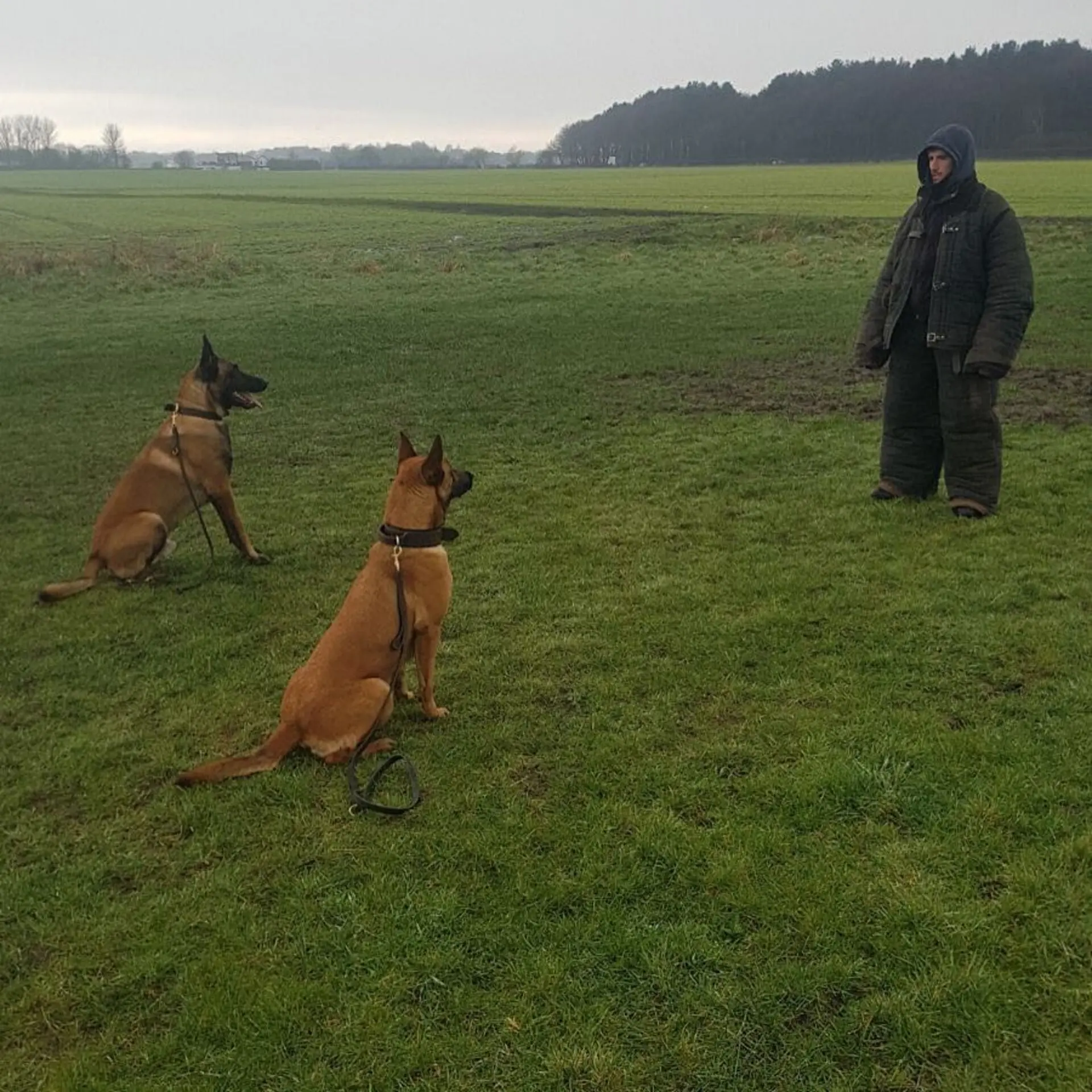
Some dogs can complete professional protection dog training, but not every dog has the temperament, health, confidence or obedience required. Breed and size alone do not determine suitability.
A reliable protection dog must remain calm during everyday family life, respond consistently to its handler and act only in controlled circumstances. A professional assessment should therefore take place before any protection training begins.
Based in Formby, Merseyside, LinkK9 has worked with families, individuals and business owners since 2002. Founder Rory Larsen personally assesses a
What Is a Protection Dog?
A protection dog receives specialist training to recognise and respond to potential threats while remaining under the handler’s control.
A properly trained dog should behave calmly at home and in public. It should follow clear commands, stop immediately when instructed and distinguish everyday situations from genuine threats.
Professional protection dog training UK programmes may include:
- Advanced obedience under pressure
- Reliable recall and stop commands
- Confidence in unfamiliar environments
- Controlled responses to simulated threats
- Safe behaviour around family members and visitors
- Clear communication between the dog and handler
Protection training should develop stability and control rather than encourage uncontrolled aggression.
Protection Dog vs Guard Dog: Key Differences
The main difference involves control and integration into everyday life.
A guard dog may protect a fixed location and react with limited handler direction. A personal protection dog or family protection dog usually lives closely with its owner and responds according to structured training.
A suitable protection dog should:
- Remain calm when no threat exists
- Follow commands consistently
- Stop protective behaviour immediately
- Integrate safely into normal family routines
- Behave appropriately in public
At LinkK9, control forms the foundation of all protection work. A dog must learn when to respond, when to stop and when to relax.
Can Any Dog Be Trained as a Protection Dog?
No. Many well-behaved family pets do not have the characteristics required for protection work.
Working breeds often associated with this training include German Shepherds and Belgian Malinois. However, being a particular breed does not automatically make a dog suitable.
A German Shepherd protection dog or Belgian Malinois protection dog still needs stable nerves, sound health, reliable obedience and the ability to recover quickly after pressure or surprise.
Aggression also does not indicate suitability. Fearful, reactive or unpredictable dogs may create significant safety and welfare risks if pushed into protection training.
What Makes a Dog Suitable for Protection Training?
Professional trainers consider the whole dog rather than focusing on appearance, breed or physical strength.
Signs Your Dog May Be Suitable
A potentially suitable dog may demonstrate:
- Stable confidence in unfamiliar places
- Strong engagement with its handler
- Reliable basic obedience
- Good recovery after unexpected noise or movement
- Controlled awareness of people and surroundings
- Appropriate physical health and maturity
- The ability to settle calmly at home
These characteristics do not guarantee that a dog will progress. They indicate that a professional protection dog assessment may be worthwhile.
Signs Protection Training May Not Be Appropriate
Protection training may not suit dogs that display:
- Anxiety or fear-based behaviour
- Unpredictable aggression
- Poor recovery after stressful situations
- Physical or health limitations
- Limited focus or engagement
- Weak basic obedience
- Difficulty settling in everyday environments
Choosing not to continue can be the safest and fairest decision for the dog and its household.
How Is a Dog Assessed for Protection Training?
A professional protection dog assessment examines how the dog behaves in several controlled situations.
The trainer may evaluate:
- Temperament and emotional stability
- Confidence in new environments
- Response to controlled pressure
- Obedience and handler engagement
- Social behaviour around people and dogs
- Physical condition and maturity
- Ability to calm down after stimulation
The purpose is not to make a dog react aggressively. It is to determine whether the dog has the stability, confidence and control needed to progress safely.
An experienced trainer should provide honest guidance when a dog does not meet the required standard.
What Does Protection Dog Training Involve?
Effective protection dog training UK programmes develop obedience, confidence and handler control before introducing advanced protection exercises.
Advanced Obedience and Control
The dog must respond reliably to commands in calm and distracting environments. Recall, heelwork, stays and stop commands provide the foundation for later training.
Confidence and Environmental Training
Dogs may train in varied surroundings so they can remain composed around unfamiliar noises, surfaces, vehicles, people and situations.
Controlled Protection Work
Professional trainers introduce carefully managed scenarios and specialist bite work where appropriate. The dog must act only within a structured exercise and release immediately when commanded.
Handler Training and Family Integration
The owner must understand how to communicate with and manage the dog. Training may cover household boundaries, visitors, children, public settings and ongoing practice.
LinkK9 provides one-to-one support and residential dog training in Formby, Merseyside, depending on the dog’s needs and stage of development.
How Long Does Protection Dog Training Take?
There is no fixed timeline. It depends on the dog’s starting point and capability.
In general:
- Foundation obedience may take several weeks
- Advanced protection work can take months
- Ongoing training and refresher sessions are essential
At Link K9, we work with a limited number of dogs to maintain quality and consistency.
Is Protection Dog Training Safe and Ethical?
Protection training can be safe and ethical when an experienced professional prioritises control, welfare and responsible handling.
An ethical programme should:
- Protect the dog’s physical and emotional well-being
- Build confidence rather than fear
- Avoid encouraging uncontrolled aggression
- Use clear and consistent communication
- Match the training to the individual dog
- Stop when the dog shows that the work is unsuitable
The aim is to produce a stable, manageable dog rather than an unpredictable one.
Can a Protection Dog Live Safely With a Family?
A suitable family protection dog should integrate into everyday home life and remain calm when protection is not required.
However, successful family integration depends on careful selection, early socialisation, consistent boundaries and responsible adult supervision. Owners must consider children, visitors, other pets and the household’s daily routine.
No trainer should assume that every protection dog will suit every family. The dog’s temperament and the household’s experience must be considered together.
Legal Responsibilities for Dog Owners in the UK
Owners remain legally responsible for their dogs. In England and Wales, it is against the law to allow a dog to become dangerously out of control, including in a public place, on private property or in the owner’s home.
Owners must also meet their dog’s welfare needs and prevent unnecessary suffering. Dogs must be microchipped and registered by eight weeks old and wear a collar and identification tag in public.
Secure handling, suitable insurance and clear communication with visitors also support responsible ownership.
Should You Train Your Dog Yourself?
Protection work is not suitable for online tutorials or home experimentation. Mistakes can reinforce fear, confusion or unsafe behaviour.
Use an experienced professional who can assess the dog, structure the training and coach everyone responsible for handling it.
What Are the Alternatives if My Dog Is Not Suitable?
A dog that does not suit protection training may still benefit from:
- Advanced obedience
- Confidence-building exercises
- Behavioural support
- Improved household management
- Additional home security
Another option may involve choosing one of the professionally raised and trained protection dogs that UK specialists provide. This route allows trainers to assess the dog throughout its development and match it more carefully to an appropriate home.
Questions to Ask Before Starting Protection Dog Training
Ask yourself:
- Why do I want a protection dog?
- Can I provide consistent handling and clear boundaries?
- Is everyone at home comfortable with the responsibility?
- How will the dog fit around children, visitors and other animals?
- Can I commit to ongoing training?
- Can I accept that my dog may not be suitable?
Final Thought
health, obedience, confidence, emotional stability and the owner’s ability to provide consistent handling.
The safest first step is a professional protection dog assessment. This should identify whether training may be appropriate or whether another form of support would better protect the dog’s welfare and the household’s safety.
At LinkK9, Rory Larsen personally assesses and trains every dog. The focus remains on careful selection, family integration, reliable control and honest guidance rather than forcing unsuitable dogs through protection work.